
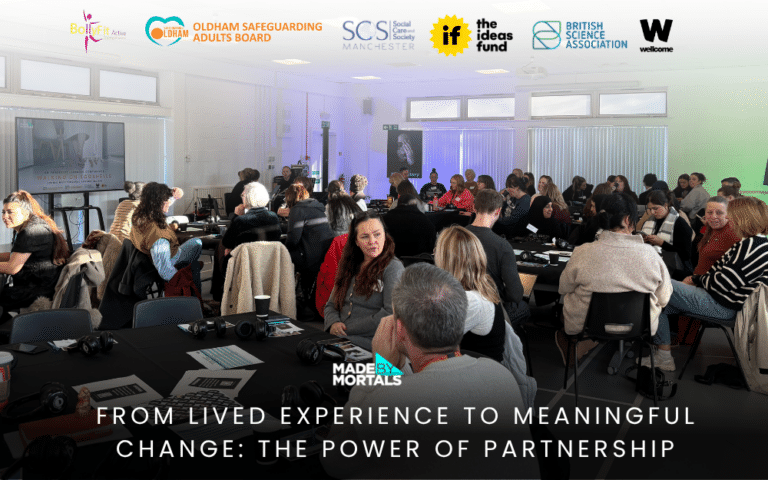
What happens when an arts organisation and a safeguarding board join forces?
Our Relationship Manager Tess meets James and Catherine from Oldham’s safeguarding partnerships to explore how creative work can carry lived experience into the heart of the safeguarding system, and how a good partnership can turn powerful stories into real change.
Picture a room full of the most senior people in Oldham’s safeguarding system. Leaders from the police, the NHS, social care and seventeen other partner agencies have gathered to plan the board’s next three-year strategy. They are busy people with a packed agenda ahead of them.
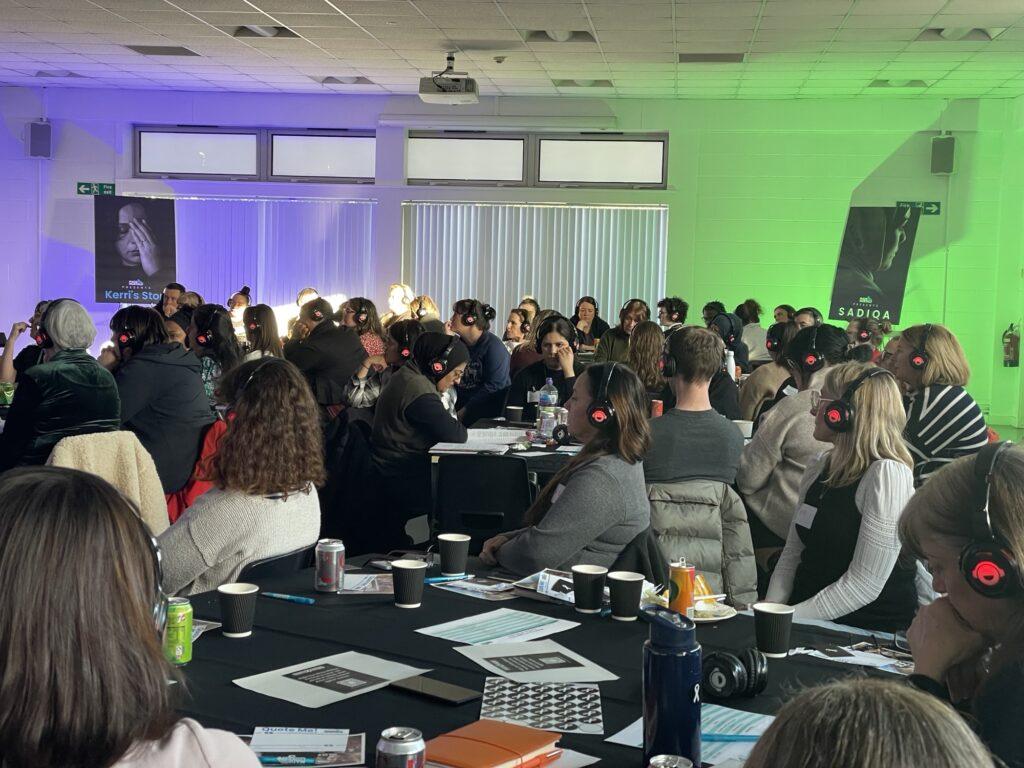
Now picture them wearing blindfolds and headphones.
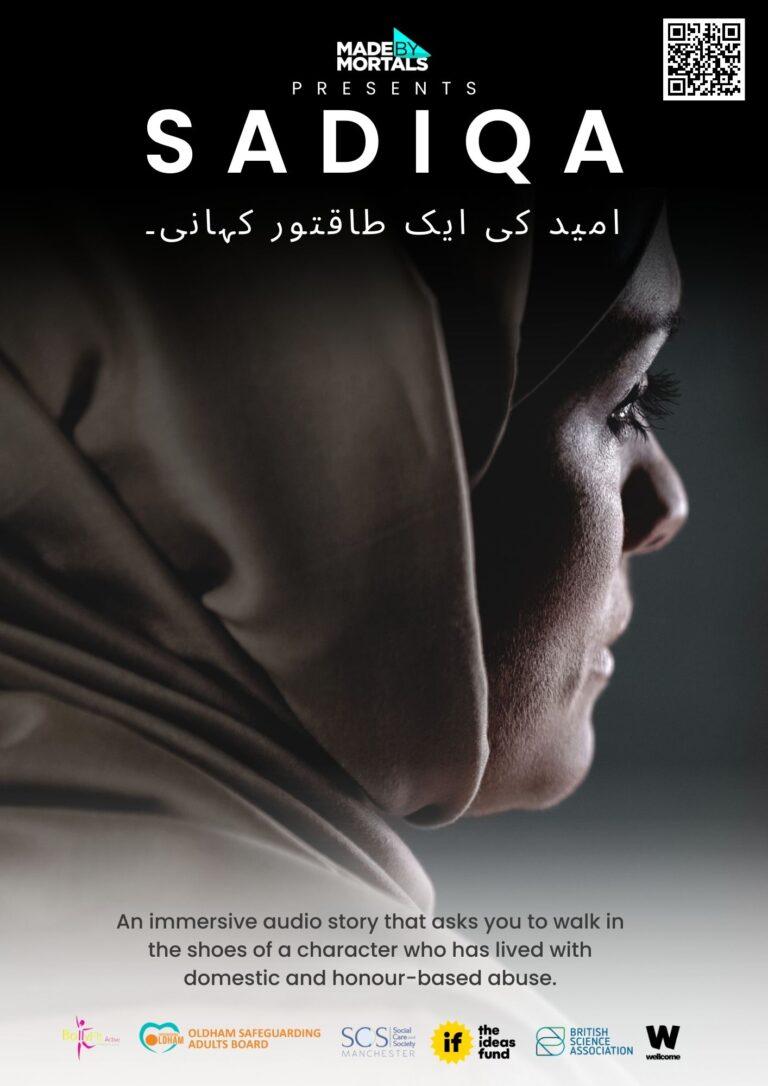
They’re listening to Sadiqa, an immersive audio drama about so-called honour-based abuse, shaped by the lived experience of South Asian women in Oldham. They hear the sounds of a women’s group meeting, voices in different languages, and the inner thoughts of a woman that no case study on a slide could ever carry. When the headphones come off, the room turns to strategy “with that lived experience ringing in their ears,” as James puts it. “Literally.”
I’m thinking about that room as I sit down with James and Catherine on a bright winter morning in Oldham. We’re leaning in over the coffee table so we can hear each other, and it’s lovely to see them again. It’s the first time the three of us have been together since we ran a conference day together in November (more on that later), and there’s a lot to catch up on.
In our last blog, I talked to Aneela and Sue at ARC-GM about what makes co-creation with a research partner work. Today I want to pick up where that conversation left off. Once research and lived experience have been shaped into something powerful, how does that knowledge actually travel? How does it get from a group of women sharing their stories into a boardroom, a training room, or the plans of a whole safeguarding system?
At Made By Mortals, our theory of change is simple: lived experience + high-quality creative methods and outputs = high impact and change. What I want to understand today is what happens to that equation when you add a partner like Oldham Safeguarding Adults Board. As we talk, it becomes clear that the answer lies in the relationship, and that when it’s working, the whole becomes greater than the sum of its parts.
Picking up the mantle
James is business manager of Oldham Safeguarding Adults Board, a statutory partnership of twenty agencies whose work is driven by learning from cases where things haven’t gone well. Catherine is a training consultant for the Oldham Safeguarding Children Partnership. Their world is identifying local safeguarding priorities and ensuring all relevant partner agencies work together to protect children and adults from abuse and neglect
Ours is made of stories, music and imagination. What connects us is a shared belief that the people who have lived through something hold knowledge nobody else has, and that, handled with care, that knowledge can change things.
Like my conversation with Aneela and Sue, this partnership began before my time, and before James’s too. In 2020, his predecessor, Julie Farley, worked with Made By Mortals on Rats in the Sofa. When James stepped into the role, he picked up the relationship and made it his own.
That rarely happens. Partnerships live and die on individual relationships, and many quietly fade when one person moves on. This one grew. It was helped by the unusually close links between Oldham’s adults’ board and children’s partnership, which is how Catherine came to be invited in. She was the only person from children’s safeguarding involved in the adults’ board’s work on older people and domestic abuse, but she could see why that mattered. “We need to think family and generations,” she says, “and who might be safe people in those generations. In another local authority, I may never have been involved.”
From a question to a short film
When the Ideas Fund later funded us to bring communities and researchers together, we wanted to focus on domestic abuse, a pressing and ongoing concern in Oldham and one the safeguarding partnerships are consistently working on. That made the Safeguarding Adults Board a natural partner. We worked alongside researcher Dr Saqba Batool, then at the University of Manchester, and early on the work included focus groups with women in the community about their experiences of domestic abuse. As a South Asian woman, Saqba could speak to so-called honour-based abuse in a way Catherine felt she couldn’t. “It was fantastic that we had a researcher and someone from the local universities,” Catherine says.
Catherine added one question to the focus groups: what about older women? National crime data had historically stopped counting people in their fifties, and she had a hunch that something was being missed.
She was right. Women told them that the physical violence might have eased as they and their partners got older, but that the coercive control had become worse. These women were almost invisible, both to the data and to the systems meant to protect them.
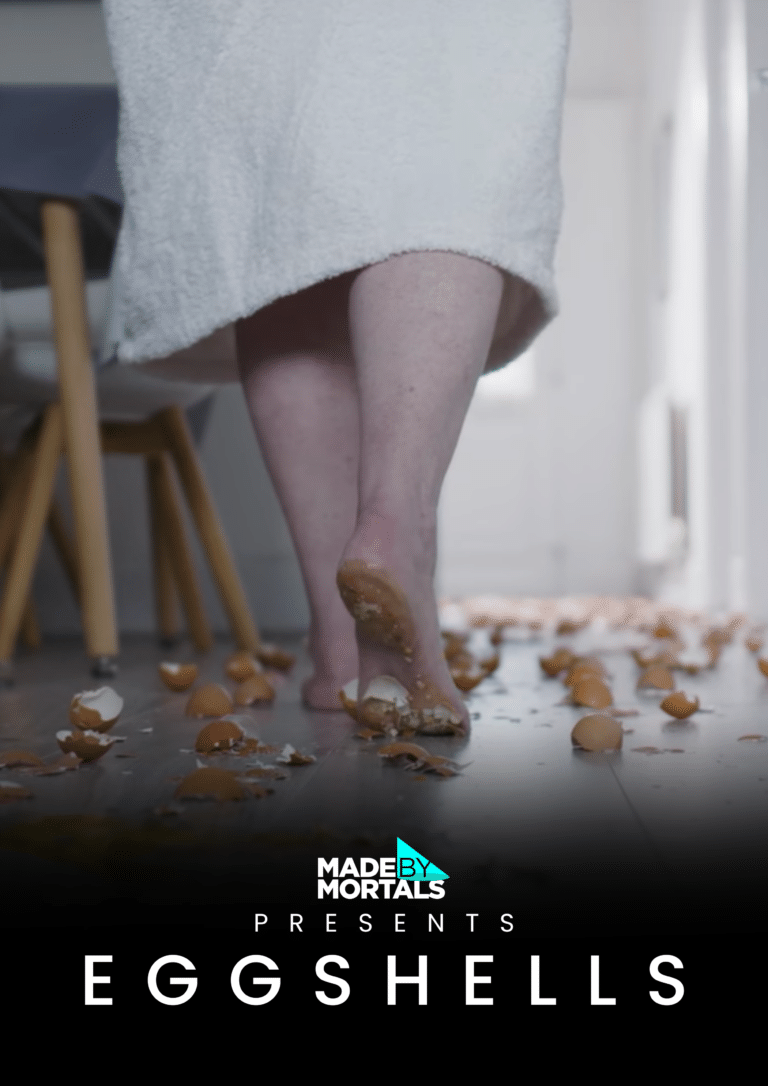
That finding was where the knowledge began its journey. Women with lived experience met week after week in a coffee shop with our artists and musicians. Together they shaped a short film, Eggshells.
Catherine was often in the room. By what she calls a happy accident, she is also a trained therapist, and she quietly made sure everyone left each session in an okay place. “They weren’t just turning up,” she says of the women. “It was coming from the heart.”
Eggshells has now been viewed more than a million times on YouTube, with over two thousand comments from people around the world recognising their own lives in it. But the numbers are only part of the story. What interests me today is everything that had to happen between the people around this table for the work to go where it has.
Learning each other’s language
When Catherine first met Paul, our CEO, her job was essentially to teach an arts organisation what coercive control is. “I could see Paul and others really absorbing that knowledge,” she remembers, “and I could see it being used when things were being developed.”
The learning flowed back the other way too. One of my very first sessions at Made By Mortals was co-delivering Sadiqa at a safeguarding training day at Oldham’s Civic Centre. My colleague Chris talked me through everything the team had learned about holding a room safely. That ranged from opening with a clear self-care message to having named people participants could go to if they needed to talk. Catherine was one of those people that day.
“Everything that we suggested has been taken on board,” Catherine says. “It has been a proper partnership. We’ve all got our different skill sets and they’ve been blended together very, very well.”
Trust, built step by step
It turns out that first session of mine was a turning point for James too. He was in the room, just a couple of months into his new role and, as he puts it, “very green”. He remembers coming out and turning to Catherine in the corridor. “This is brilliant,” he told her. “It’s getting to practitioners. The senior leaders need to hear this.”
Getting there took care, and time. Bringing lived experience into safeguarding is powerful, and all three of us feel the weight of doing it well. “It’s got to be done right,” Catherine says.
James draws that care as a triangle. “There’s three sort of points on the triangle,” he says. “You’ve got you guys, who have all of that arts expertise. Catherine and I bring in the subject matter experts. And then people with lived experience.” Each side needs to be open, he adds, and that openness only comes from mutual respect.
Only once that trust was in place could the work move up to the board itself. “You wouldn’t bring people you’d just met into the board space to start training the directors of all of our organisations,” James says. Even then, it was a risk. “You don’t know how it’s going to be taken.” It paid off and set the tone for the rest of the day. Catherine calls it “a stroke of genius” and would love to do the same with the children’s partnership.
This is where I can see our equation growing. On its own, a powerful story can move a room. With a partner who trusts you enough to open the boardroom door, it can help shape a three-year strategy.
One team
In November 2025, all that trust came together on a single day. The three of us were part of a steering group that created a full conference, Walking on Eggshells: Ending Male Violence Against Women. Oldham is a White Ribbon accredited council, and James and Catherine suggested holding the event on White Ribbon Day, 25 November, the international day calling for an end to men’s violence against women.
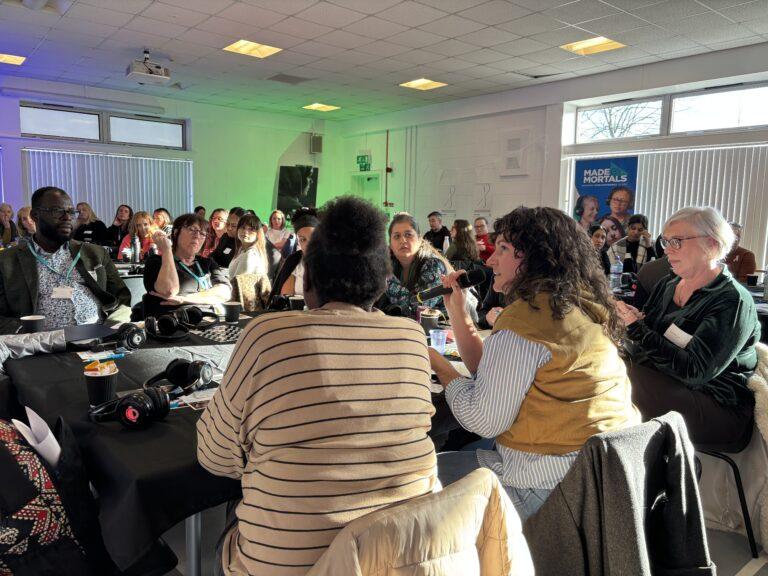
With part of the conference focused on boys and young men, it was the perfect fit. Saqba was with us again too, this time helping us measure the day’s impact.
Even after years of working together, we kept checking. Catherine remembers us coming back to the steering group again and again, asking, “Are these questions okay? Is this language okay?” For her, that is where trust comes from. “It’s a constant loop,” she says.
I felt that responsibility strongly on the day. The expertise was all in the room. As facilitators, we didn’t want to position ourselves as the experts, but we had to know enough to guide the conversation well. That knowledge came from years of exactly this back and forth.
The day brought three of our co-produced stories on this topic together for the first time: Eggshells, Kerri’s Story and Sadiqa. It also included something we had never tried before: building a fictional practitioner, “Jessica”, with the whole room, accompanied by live musicians. People poured their own experience into her, talking about vicarious trauma and how heavy this work can be to carry home. James and Catherine had trusted us to try something new, and it was one of the most powerful parts of the day.
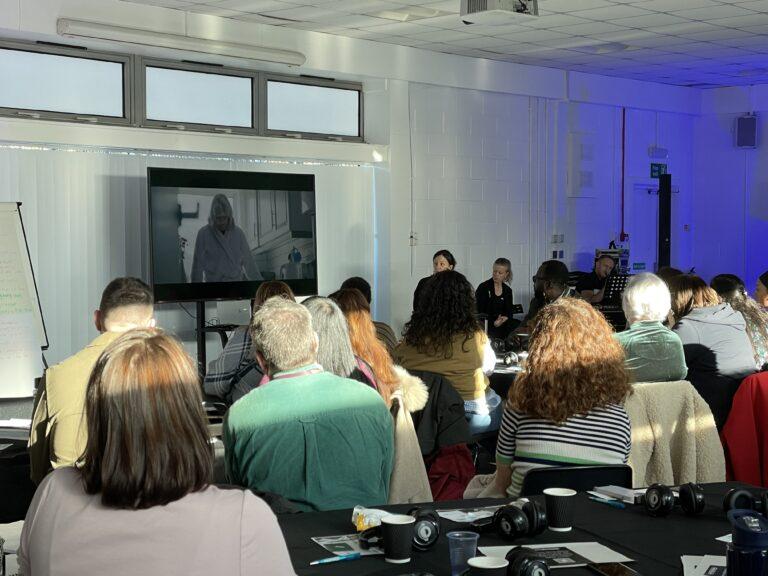
On the day I realised I hadn’t included a model Catherine had suggested, and I went to her full of apologies. She waved it away. “It was that mutual respect about each other’s specialism,” she says now. “It was just unsaid but understood. It was like we were all one team.”
For James, the proof is in the coming back. “I have no hesitation in saying to the partners, we want to go back to Made By Mortals.”
How knowledge travels
This is the part the Ideas Fund has been especially curious about. Research led to lived experience, and lived experience became stories. A statutory partnership that believes in those stories has then carried them into places we could never have reached on our own.
For practitioners, the stories offer a way in that a written case study can’t. “You’re using different senses,” Catherine says. “You don’t have a choice but to engage.”
For senior leaders, they are a way of reconnecting with what sits behind the figures they review. “It’s quite easy when you’re busy to become desensitised,” she says, “to see things as stats and returns and numbers, and not what’s actually going on in somebody’s house.” The work also features in the annual reports the boards publish to show the public how they are responding.
And the knowledge keeps returning to the women who shaped it. They still wanted to come and see their work in action at the conference, and one of the women from Eggshells made it on the day. I still send her the latest view counts and feedback.
Catherine and James are already thinking about what comes next for Oldham. The safeguarding partnerships are shaping a new domestic abuse strategy, and Catherine would love to see a lived experience group set up as part of it. People who have come through abuse could help shape the strategy and even train others to use resources like ours. She’s also thinking about how community groups could be supported to use Sadiqa safely.
Essential ingredients
Before we go, I ask what makes a partnership like this work. James talks about people on both sides “wanting and willing to try something new and different”. Catherine talks about mutual respect, no hierarchy and not being precious. Both come back to trust.
When all of that comes together, with shared priorities, care, trust and a friendship built over years, something like magic happens. Lived experience and creativity can change things on their own. With a partnership like this one, they can change far more.
As we gather our things, James is smiling. “It’s exciting,” he says. “I feel like the more you reflect on things like this, it gets you excited to do similar things again.”
I feel exactly the same.
Five key takeaways:
- Invest in the relationship, especially when people move on
Partnerships are built between individuals, not logos. When someone moves on, a thoughtful handover and time spent building a relationship with the person taking over are vital to keeping the partnership alive and helping it grow. - Bring three kinds of expertise, and keep all three open
Creative expertise, subject expertise and lived experience each hold part of the picture. The magic happens when each side is open to learning from the others. - Let trust open the doors
Knowledge travels along lines of trust. Each successful step, from a workshop to a boardroom to a conference, earns the right to take the next one. - Keep the loop going
Checking in never stops being part of the work. Keep asking “Is this right? Does this feel safe? Are we listening?”, however far the work has come. - Design for the journey, not just the output
Make things that can travel, and find partners who can carry them into practice, strategy and communities. That journey is where research becomes real change.
Looking for ways to bring lived experience into your work?
Sign up for our Members Area to access audio stories, training materials, and workshop guides—all themed around key health & social care topics. Start exploring today!
For more information about how Made By Mortals can support your project including a quote, please email admin@madebymortals.org or call 0161 804 2078